Last updated November 17, 2026




Free written scope consultation - allowances, timeline, and change-order rules on paper before a single trade is scheduled
Driveway & Pavers Maintenance Checklist for Lewisville Homeowners
Most paver driveways in Lewisville don’t fail because they were installed badly. They fail because nobody touches them between installation day and the first big problem. The assumption is that pavers are “set it and forget it,” and that assumption costs homeowners money. North Texas hands your driveway a brutal one-two punch every year: a hard freeze or two in January, then long stretches near 100°F by August. That swing works on joint sand, sealer, and the base underneath in ways a milder climate never would. The good news is that a driveway responds well to small, well-timed attention. This checklist gives you specific actions tied to specific months, not vague “seasonal maintenance” advice you’ve read a hundred times.
Quick Answer
Maintaining a driveway or paver surface in Lewisville comes down to three checkpoints a year: seal and prep before the first freeze in November, inspect and refill joints after winter in March, and check for heat-driven shifting in July. Between those windows, keep the surface clean, keep water draining away from the house at a minimum 1% slope, and never power wash pavers at high pressure. Do those things and a well-built driveway will outlast one that gets ignored.
Styles & brands we work with
- Kitchen remodeling
- Bathroom remodeling
- Home additions & ADU
- Roofing
- Windows & doors
- Driveway & pavers
- Fence
Table of Contents
- Why Lewisville’s Climate Is Hard on Pavers
- The Month-by-Month Paver Maintenance Calendar
- Choosing the Right Sealer for Concrete Pavers vs. Natural Stone
- Joint Sand Failure: DIY Refill or Base Failure?
- Checking Your Drainage Slope Before Spring Rain
- What Voids a Paver Warranty (and the Mistakes That Do It)
- Cleaning Without Damage: Pressure, Products, and What to Skip
- Small Repairs You Can Handle vs. Work That Needs a Pro
Why Lewisville’s Climate Is Hard on Pavers
Paver driveways in Lewisville live through a wider temperature range in a single year than many materials are designed to handle gracefully. A January cold snap can push the ground into a freeze, and by August the same surface is baking in sustained heat. That expansion and contraction cycle is what stresses joint sand, opens hairline gaps, and gradually works loose the bedding layer under the surface.
Then there’s the rain. Spring in North Texas brings heavy, fast downpours. Water is the single biggest enemy of a paver driveway, not because pavers can’t get wet, but because water that pools or runs toward the house instead of away from it finds every weak point in the base. A driveway that drains correctly handles a downpour fine. One with a flat or reversed slope starts showing sand loss, settling, and rocking pavers within a season or two.
Lewisville sits in a part of the metroplex where the soil is a mix of clay and loam. Clay-heavy soil expands when wet and shrinks when dry, which is exactly the cycle the local weather delivers. A paver base built to spec with proper compaction and a good aggregate handles that movement. A base that was rushed does not, which is why base quality and drainage matter as much as the pavers themselves.
This is also why material selection deserves real thought before installation, not after. When we walk homeowners through their options, we do it before a single measurement is taken, because the difference between a utility-grade concrete paver and a premium collection from Techo-Bloc or Cambridge Pavers shows up in how the surface ages under this climate. Choose from brands like Belgard, Unilock, Tremron, and Cambridge Pavers – we work with all of them, and the right pick depends on your driveway’s exposure, traffic, and the look you want. Getting that decision right up front makes every maintenance task in this guide easier.
The Month-by-Month Paver Maintenance Calendar
Generic advice tells you to “maintain your pavers seasonally.” That’s not useful. What actually works in Lewisville is a calendar tied to the local weather pattern, because each of the three windows below targets a specific stress the climate is about to apply.
November: Pre-Freeze Sealing and Prep
Before the first hard freeze, seal the surface and top off joint sand. Sealer locks sand in place and slows water absorption, which reduces the damage a freeze can do to saturated joints. This is the most important window of the year.
March: Post-Winter Inspection and Joint Refill
After winter, walk the driveway and look for popped joints, loose sand, and any pavers that have shifted or begun to rock. Refill joints with fresh polymeric sand where the sand has washed or blown out. Catch small movement now, before spring rain works it into a bigger problem.
July: Heat Expansion and Edge Checks
Peak summer heat causes the most expansion. Check the edges where the driveway meets the garage, walkways, or lawn. Edge restraint failure is common in summer because the pavers push outward as they expand. A lifting or cracked edge restraint lets the whole field start to spread.
Monthly, Year-Round
- Blow or sweep off leaves and debris so water can move across the surface freely.
- Check that downspouts and gutters aren’t dumping water onto the driveway.
- Look for new puddles after rain. Standing water means the slope has shifted.
- Pull weeds from joints early, before roots widen the gaps.
That’s three deep sessions and a few minutes of routine care. Compared to a full re-set or a base repair, the time investment is small. Our technicians have up to 12 years of experience, and the pattern holds: the driveways that get these three checkpoints are the ones that stay flat and tight for the long haul.
Choosing the Right Sealer for Concrete Pavers vs. Natural Stone
Not every sealer works on every paver material, and applying the wrong one can trap moisture, dull the finish, or leave a cloudy film. Before you buy a sealer, know what your driveway is made of.
Concrete pavers are the most common choice in Lewisville driveways, and they take a penetrating or film-forming sealer well. For concrete pavers, a quality polymeric sand paired with a compatible sealer from a brand like Techniseal is a proven combination. The polymeric sand hardens in the joints to lock pavers together and resist washout, and the sealer protects the surface and deepens color. Match the sealer to the paver’s finish – matte, satin, or gloss – and follow the manufacturer’s coverage and cure instructions exactly.
Natural stone pavers behave differently. Stone is porous in its own way and often needs a breathable, penetrating sealer rather than a heavy film-forming product. A film sealer on stone can trap moisture and cause spalling or discoloration. Use a sealer formulated specifically for natural stone, and test a small, hidden area first.
Sealer Selection Quick Guide
- Identify your paver material: concrete, clay brick, or natural stone.
- Match the sealer type to the material – film-forming for most concrete, breathable penetrating for natural stone.
- Confirm compatibility with your joint sand, especially if you used polymeric sand.
- Check the weather forecast: seal when the surface is dry and no rain is expected for the cure window.
- Test on a small area before doing the whole driveway.
If you’re not sure what material you have or which sealer your pavers were designed for, that’s a good reason to get an expert opinion rather than guess. A wrong sealer is harder to undo than it is to avoid.
Joint Sand Failure: DIY Refill or Base Failure?
Joint sand loss is normal and expected. The question that matters is whether the missing sand is routine wear or a symptom of something deeper. Getting the diagnosis right saves you from refilling joints over and over on a driveway that actually needs base work.
When It’s a DIY Refill Job
- Sand is missing uniformly or in scattered spots after rain or wind.
- The pavers themselves are stable, flat, and don’t rock when you step on them.
- Gaps are narrow and consistent, not widening in one area.
- Water still drains across the surface rather than pooling.
In these cases, sweep fresh polymeric sand into the joints, mist it to activate, and let it cure. This is a straightforward maintenance task.
When It Signals Base Failure
- Pavers rock or “teeter” underfoot in a specific area.
- Joint gaps are widening in one zone while staying tight elsewhere.
- The surface is dipping or settling into a low spot.
- Sand washes out repeatedly from the same place no matter how often you refill.
- Water pools in a depression instead of draining away.
Those signs point to a problem under the surface – a base that wasn’t compacted enough, a drainage issue, or a failed edge restraint letting the field spread. Refilling sand over a failed base is like painting over rot. The fix is to lift the affected pavers, correct the base, and re-set them. That’s professional work. If you’re seeing any of the second list, it’s worth having it looked at before spring rains find the weak spot.
Checking Your Drainage Slope Before Spring Rain
A paver driveway needs a slope of at least 1% away from the structure. In plain terms, that means the surface should drop about one inch for every eight feet of run as it moves away from the house or garage. Lewisville’s heavy spring rain events make this slope non-negotiable – a driveway that drains toward the structure can push water against the foundation, into the garage, and under the pavers.
How to Check Your Slope
- Watch the driveway during a steady rain. Note where water flows and where it pools.
- After the rain, look for low spots where water evaporated last – those are your drainage problems.
- Place a long straightedge or level along the driveway, running away from the structure, and check the drop over its length.
- Confirm that water moves toward the street, a drain, or a landscaped swale, not toward the house.
- Check for edge restraint that has lifted or cracked, since a failing edge lets the field spread and flattens the slope.
If you find standing water or a slope that runs flat or toward the house, don’t wait. Water under pavers is what causes settling and base failure, and it’s much cheaper to correct a slope early than to rebuild a base later. A qualified paver contractor can re-set the affected area and restore the proper grade. If your drainage problems come from how your exterior is laid out overall – gutters, grading, and hardscape together – it helps to have one contractor who can see the whole picture, which is where a single-source construction partner pays off. driveway & pavers work, drainage corrections, and related exterior fixes can all be coordinated to keep water moving away from your home.
What Voids a Paver Warranty (and the Mistakes That Do It)
Paver manufacturers back their products with warranties, but those warranties come with conditions. Most homeowner maintenance mistakes don’t just damage the driveway – they can void the coverage you paid for when you bought premium pavers.
Common Warranty-Voiding Mistakes
- High-PSI power washing. Blasting pavers at high pressure strips the sealer, blows out joint sand, and can chip the surface. This is the single most common way homeowners damage a driveway and undercut a warranty.
- Wrong sealer or wrong application. Using a film sealer on natural stone, or sealing a wet surface, traps moisture and can cause spalling – usually excluded from coverage.
- Ignoring joint sand. Letting joints run empty for seasons lets pavers shift and rock, which is base damage the manufacturer won’t cover.
- Improper cleaning chemicals. Harsh acids or the wrong cleaners can etch or discolor the surface.
- Unapproved repairs. Lifting and re-setting pavers without proper base compaction can void coverage on the affected area.
The pattern behind all of these is the same: damage that a manufacturer reads as owner error rather than product failure. Following the manufacturer’s maintenance instructions protects both the driveway and the warranty. Working with a contractor who installs to the manufacturer’s spec – and knows which brands back their products how – keeps you on the right side of that line. Seven distinct manufacturer relationships on the paver side alone, from Belgard to Cambridge, mean real design variety and product warranties a single-brand installer can’t match.
Cleaning Without Damage: Pressure, Products, and What to Skip
Regular cleaning is part of maintenance, but the wrong cleaning does more harm than good. The rule for paver driveways is low pressure and the right product.
Safe Cleaning
- Sweep or blow off debris regularly so it doesn’t stain or hold moisture.
- Use a garden hose or a low-pressure washer on a wide fan tip, keeping the nozzle moving.
- Use a cleaner formulated for your paver material, and rinse thoroughly.
- Treat stains promptly – oil, rust, and organic stains all set in faster in summer heat.
What to Skip
- High-PSI pressure washing, especially on a narrow tip held close to the surface.
- Acid-based cleaners that can etch concrete or stone.
- Sealing over a dirty or damp surface – it locks in stains and moisture.
- Metal tools that can chip paver edges when removing weeds or debris.
Clean surfaces drain better and show problems earlier. A driveway that’s swept and rinsed routinely lets you spot a widening joint or a new low spot before it becomes expensive. Keeping up with cleaning also means your sealer lasts longer, which pushes your next sealing window further out.
Small Repairs You Can Handle vs. Work That Needs a Pro
Some paver maintenance is genuinely DIY-friendly. Some of it isn’t, and knowing the difference protects both your driveway and your back. Here’s how to sort it.
Reasonable DIY Tasks
- Refilling joint sand with polymeric sand on a stable, flat driveway.
- Pulling weeds from joints by hand or with a joint knife.
- Sweeping and low-pressure rinsing.
- Spot-cleaning stains with a material-appropriate cleaner.
- Replacing a single loose paver that lifted but sits on an intact base.
Work That Needs a Professional
- Any area where pavers rock or the surface has settled.
- Slope corrections and drainage fixes.
- Base repair or re-compaction.
- Edge restraint replacement.
- Sealing a large or premium driveway, where a bad application is costly to reverse.
- Any repair on an area with an active warranty claim.
If you’re planning a larger exterior project and pavers are one piece of it, that’s another reason to work with one contractor across the whole scope. From the roof down to the driveway edge, coordinating exterior work through a single partner avoids the finger-pointing that happens when a drainage problem sits between two different trades. Construction Lewisville handles driveway and paver work alongside fencing, windows, and roofing so the pieces fit together.
Common Mistakes to Avoid
- Power washing at high PSI. It strips sealer and blows out joint sand, and it’s the fastest way to void a manufacturer warranty. Use low pressure and a wide fan tip, or hire it out.
- Sealing on the wrong day. Sealing a damp surface or sealing before rain traps moisture and can cloud the finish. Check the forecast and confirm the surface is fully dry first.
- Ignoring the drainage slope. A driveway that drains toward the house lets Lewisville’s spring downpours push water against the foundation. Check the 1% slope at least once a year.
- Refilling sand over a failed base. If pavers rock or a joint gap keeps reopening in the same spot, the problem is underneath. Refilling hides it for a season and then fails again.
- Skipping the fall sealing window. Waiting until after the first freeze means sealing a surface that’s already stressed by winter. November is the window to hit.
- Using the wrong sealer on natural stone. A film sealer on porous stone can trap moisture and cause spalling. Match the product to the material.
- Letting weeds and debris sit. Roots widen joints, and debris holds moisture. A few minutes of sweeping beats a repair later.
See the difference
 Before
 After
 Before
 After
 Before
 After
When to Call a Professional
Call a professional when the problem is under the surface or the stakes are high. Rocking or settling pavers, standing water after rain, a slope that runs toward the house, cracked or lifted edge restraint, and joint sand that washes out of the same spot over and over are all signs that a refill won’t fix it. Those situations need the base corrected and the pavers re-set properly. The same goes for sealing a large or premium driveway – a bad seal is far harder to undo than to avoid. If your driveway is tied to other exterior work like fencing or roofing, having one contractor coordinate it all saves you from untangling who’s responsible for what. Construction Lewisville offers free estimates in Lewisville – call (833) 620-6067. Our technicians have up to 12 years of experience, and estimates are free with a written, line-item quote so the price is set before work starts.
Frequently Asked Questions
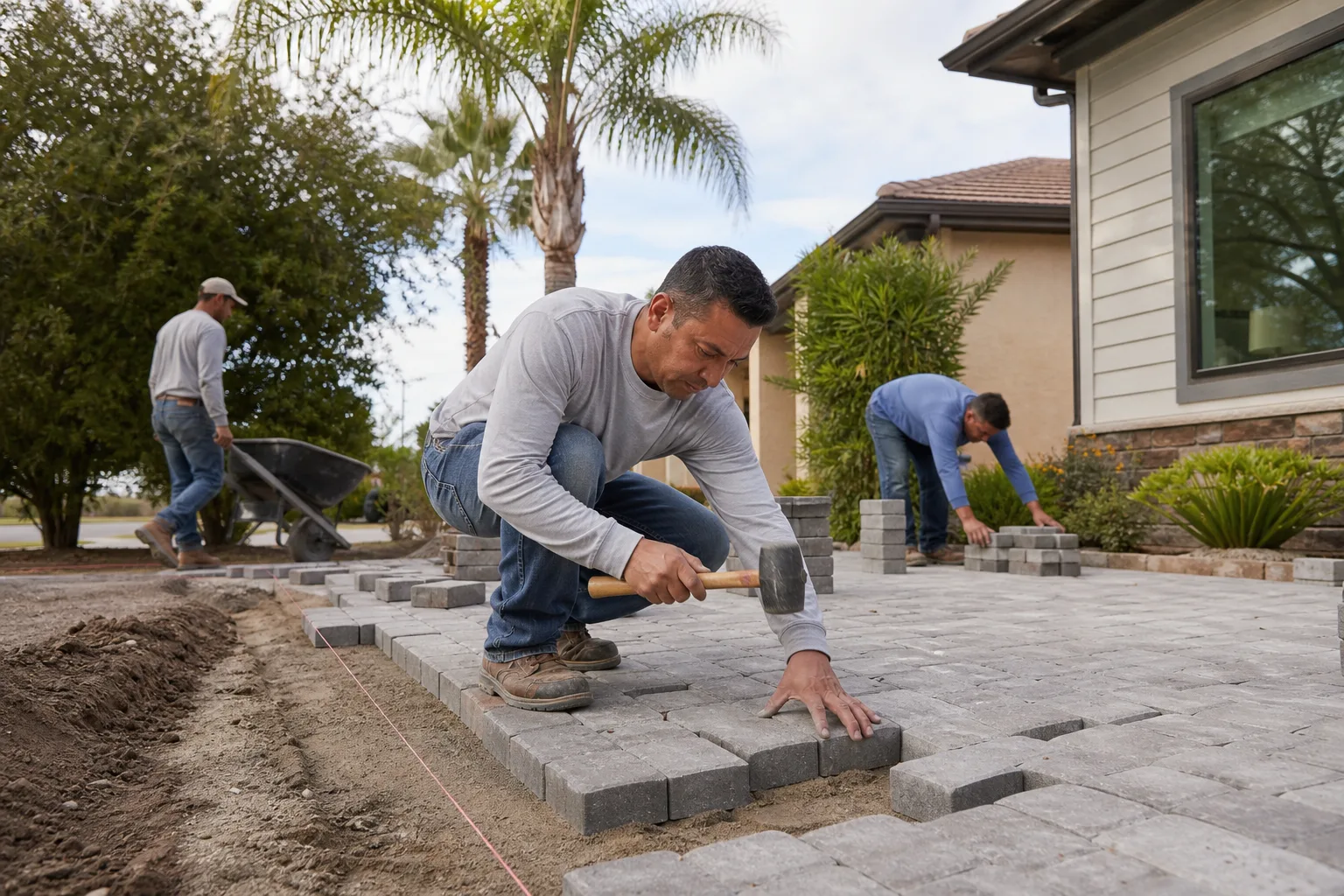
Most paver driveways in Lewisville do well with sealing roughly every two to three years, timed to the fall window before the first freeze. A quality sealer from a brand like Techniseal protects the surface and locks in joint sand, but it wears faster under heavy traffic and summer heat. If water stops beading on the surface, it’s time to reseal. Call (833) 620-6067 for an exact quote on sealing – estimates are free.
No. We give you a written, line-item estimate before work begins, and that sets the price. If we open up a driveway and find base damage we couldn’t see from the surface, we stop and show you what we found before doing any extra work, and you approve it first. Fixed pricing with no surprise change orders is how we run every job.
Yes, in most cases. If your pavers are flat, stable, and don’t rock, and the sand loss is scattered or uniform, sweeping in fresh polymeric sand is a reasonable DIY task. If pavers rock, a gap keeps reopening in one place, or water pools, it’s a base issue and needs a professional. Call (833) 620-6067 and we’ll tell you which situation you’re in.
Uneven pavers almost always trace back to water and base issues: a slope that shifted, an edge restraint that failed, or a base that wasn’t compacted enough and let the clay-heavy North Texas soil move under it. It’s rarely the pavers themselves. Correcting the base and restoring the proper grade fixes it; refilling sand on top does not.
Yes. High-PSI power washing strips sealer, blasts joint sand out of the gaps, and can chip or etch the paver surface. It’s also one of the most common ways homeowners void a manufacturer warranty. Stick to low pressure with a wide fan tip and a material-appropriate cleaner.
A paver driveway should slope at least 1% away from the structure, which works out to about one inch of drop per eight feet. That matters in Lewisville because heavy spring rain needs to move away from the house, not toward it. If water pools or runs toward the garage, have the grade checked. Call (833) 620-6067 to schedule a free estimate on a drainage correction.
The Bottom Line
Paver driveways in Lewisville don’t need constant attention – they need the right attention at the right moments. Seal and prep before the first freeze in November. Inspect and refill joints after winter in March. Check expansion and edges in July. Keep the surface clean, protect the drainage slope, and never power wash at high pressure. Those habits protect both your driveway and your manufacturer warranty, and they head off the base failures that turn a small fix into a big one. When a problem is under the surface, get a pro to look at it early. From the first paver to the finished driveway, one contractor across every phase keeps the work coordinated and the warranties intact.
If you’re ready to protect your driveway or plan a new one, we’re glad to help. Whether it’s a maintenance check, a repair, or a full paver installation with brands like Belgard, Techo-Bloc, or Cambridge Pavers, we’ll walk you through your options before any work starts. Beyond pavers, our scope runs from fence installation to home additions & ADU projects, so your whole property can be handled by one partner – from prefab ADU options through brands like Boxabl to a full site-built addition. Choose your materials, get a written line-item quote, and let’s get it right.
Call (833) 620-6067 to schedule your free estimate. We answer 24/7. Fast dispatch from 7am to 7pm, Sunday through Friday.
Written by the team at Construction Lewisville.